
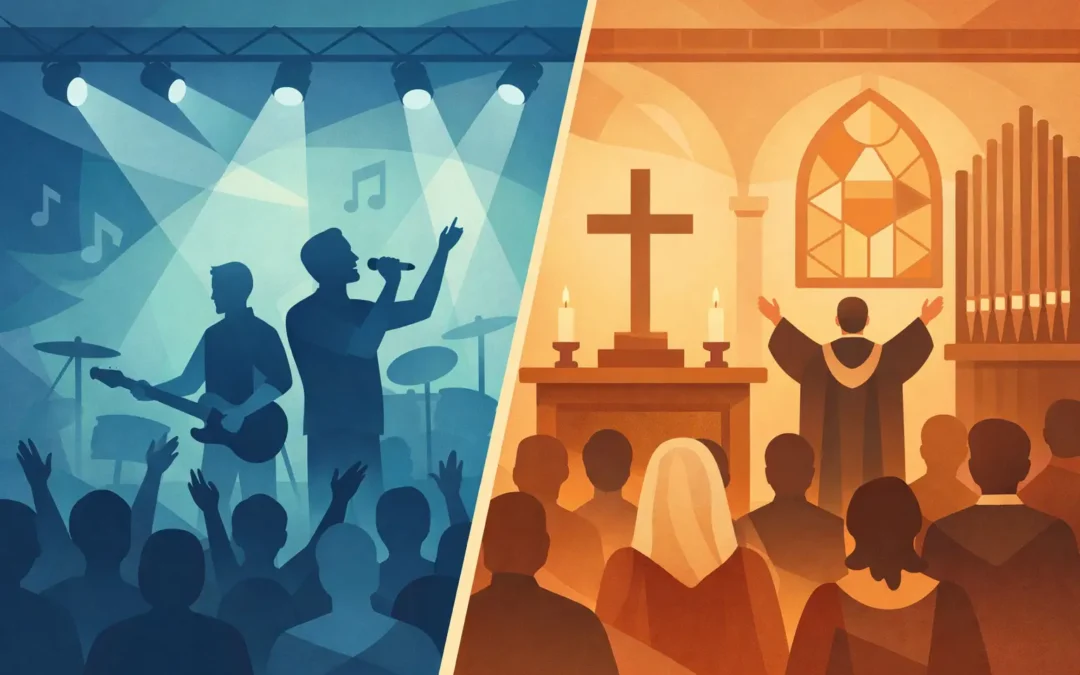
A worship service can feel familiar the moment the first song begins – or unfamiliar enough that you wonder whether you belong. For many people, the question of contemporary versus traditional worship is not really about instruments, song choices, or the volume in the room. It is about finding a place where they can meet with God, grow in faith, and worship with sincerity.
Some people are drawn to the steady beauty of hymns, liturgy, choirs, and quieter reflection. Others connect deeply through modern worship songs, a full band, expressive praise, and language that feels close to everyday life. Both experiences can be meaningful. Both can honor Jesus. And both can miss the point if our preferences become more important than the One we have gathered to worship.
Contemporary Versus Traditional Worship: The Real Difference
Traditional worship usually follows forms that have served the church for generations. It may include hymns, responsive readings, a choir, formal prayers, communion, and a more structured order of service. The music is often led by piano, organ, choir, or acoustic instruments. For many believers, these practices carry a sense of reverence and connection to the wider history of the Christian faith.
Contemporary worship tends to use newer songs, modern instruments, conversational language, visual elements, and a relaxed setting. It often creates space for people to sing freely, respond personally, and engage with biblical truth in a style that feels familiar to modern life. For a newcomer who has little church background, this can lower the barrier to participating.
Neither style automatically produces a deeper worship experience. A hymn can be sung without attention. A current worship song can be performed without surrender. The question is not simply, “Did I like the music?” A better question is, “Did this help turn my heart toward God and His truth?”
Jesus made this clear when He spoke about worshiping the Father in spirit and truth. Worship involves our hearts, but it is also anchored in who God is and what He has revealed. Feeling matters. Truth matters. We do not have to choose one over the other.
What Traditional Worship Can Offer
Traditional worship can give us a needed sense of stability. In a life full of changing schedules, shifting trends, parenting pressures, financial decisions, and constant noise, familiar prayers and historic songs can remind us that God has been faithful long before our current season began.
Many hymns are rich with biblical language and clear theology. They teach us to sing about God’s holiness, grace, sacrifice, resurrection, and future hope. A well-written hymn can carry someone through grief, uncertainty, or doubt because its message is bigger than a passing emotion.
Structure can also be a gift. Repeated elements such as prayer, Scripture reading, confession, communion, and blessing teach us that worship is more than a concert or a motivational moment. We come before God with gratitude, humility, repentance, expectation, and trust.
Still, traditional does not always mean spiritually alive. A service can be beautiful and reverent while people quietly go through the motions. Tradition serves the church best when it helps people remember and respond to the living God, not when it becomes a test of who belongs.
What Contemporary Worship Can Offer
Contemporary worship often helps people express faith in a direct and accessible way. The language may feel immediate: God is present in our struggle, Jesus is worthy of our praise, and we can bring Him our real fears and needs. For someone taking an early step toward faith, that clarity can be deeply welcoming.
Modern worship music also gives churches songs that speak to current experiences while staying rooted in Scripture. A song of surrender may help a parent release worry over a child. A song about God’s faithfulness may strengthen someone facing a difficult diagnosis or a hard season at work. Sung truth has a way of staying with us through the week.
Contemporary services can create room for joyful participation. Clapping, lifting hands, singing with energy, and praying aloud are not requirements, but they can be genuine ways to respond to God. Worship is not about performing the right outward expression. It is about bringing our whole selves before Him.
There are trade-offs here, too. Newer is not always better, and emotional intensity is not the same as spiritual depth. Churches should choose songs carefully, making sure the words are biblically faithful, centered on Jesus, and strong enough to shape a believer’s understanding of God.
Worship Is Bigger Than a Music Style
It is easy to reduce worship to the first part of a Sunday service. But worship is the response of our whole lives to God’s mercy. We worship when we sing, but also when we forgive, serve, give generously, keep our word, care for our family, and choose faithfulness when no one is watching.
That does not make gathered worship less meaningful. Singing together matters because it reminds us that faith is not meant to be lived alone. When a room full of people declares God’s goodness, the person carrying a burden may find strength to believe again. When we hear Scripture, pray for one another, and sit under biblical teaching, we are being formed as the people of God.
A healthy church service does more than give people a preferred experience. It helps people know Jesus, understand His Word, and take a next step in faith. The music should support that mission, not compete with it.
Ask Better Questions Than “Was It My Style?”
Personal preference is real. God made people with different backgrounds, personalities, and ways of connecting. It is fine to appreciate a certain worship environment. But preference should not be the only measure we use.
When considering a church, ask whether Jesus is clearly honored. Ask whether Scripture is taught with care. Ask whether the worship invites participation rather than spectatorship. Ask whether people are being encouraged to love God, serve others, grow in community, and live out their faith from Monday through Saturday.
You may also ask whether the church makes room for different generations. A teenager, a young parent, a longtime believer, and a person visiting church for the first time may not all connect in identical ways. A church does not have to please every preference in every moment. But it should communicate, through both its worship and its relationships, that every person has a place to grow.
How to Worship When the Style Is Not Your Favorite
Sometimes the worship style at a church will not be exactly what you would choose. That can be an opportunity to grow. Instead of standing back as a critic, consider entering the moment as a worshiper.
Listen to the words being sung. If they are true, let them become your prayer. Open your Bible when Scripture is read. Pray for the people around you. Thank God for the generations and backgrounds represented in the room. Your worship does not depend on whether every song is familiar.
At the same time, it is wise for church leaders to listen with humility. People who love traditional worship may be reminding the church not to lose theological depth, reverence, and its connection to Christian history. People who value contemporary worship may be reminding the church to communicate clearly, welcome newcomers, and make room for heartfelt response. We need those reminders.
A Church Family Can Hold Both Reverence and Joy
The strongest worship culture is not built around winning a style debate. It is built around a shared desire to glorify God. That can include a modern song one week and a familiar hymn another week. It can include celebration and quiet reflection. It can include people who worship with lifted hands and people who worship with bowed heads.
At True Life Church, the goal is not to create a religious performance. It is to help people encounter Jesus, grow in biblical truth, and find a church family where faith becomes real in everyday life. Whether you come with years of church experience or you are not sure what to expect, you do not have to have all the answers before you walk through the door.
The next time worship begins, take a moment to set aside comparison. Bring God your gratitude, your questions, your burdens, and your honest heart. He is worthy of more than our preferred soundtrack, and He meets people who come to Him in faith.